Last updated: October 17, 2026
The best weed removal tools target the entire root system to prevent regrowth while minimizing physical strain on your back and knees. Stand-up pullers are the most effective choice for extracting deep taproots like dandelions from lawns, while hand weeders and hori hori knives excel at precision extraction in densely planted garden beds. Matching your tool’s blade and leverage mechanism to your specific soil type is the fastest way to reclaim your yard without relying on chemical herbicides.
Key Takeaways
- Identify the root type first: Taproots (like dandelions) require deep-penetrating claws, while fibrous roots (like crabgrass) need slicing or scraping blades.
- Save your back: Stand-up weeders with lever mechanisms allow you to extract weeds from a standing position, drastically reducing lumbar strain.
- Leverage is crucial: Tools with curved heads or built-in fulcrums multiply your pulling force, making it easier to work in dense, heavy clay soils.
- Multi-purpose efficiency: A Japanese hori hori knife functions as a trowel, saw, and weeder all in one, reducing the number of tools you need to carry.
- Timing matters: Weeding is significantly easier and more effective when done 12 to 24 hours after a heavy rainfall, as moist soil releases roots with less resistance.
- Concrete requires specialty blades: Standard trowels bend in driveway cracks; use an L-shaped crack weeder to hook and slice weeds out of tight masonry joints.
Why the Right Tool Matters for Weed Control
A single dandelion can produce up to 15,000 seeds in one season, turning a minor chore into a full-blown lawn invasion if you fail to extract the taproot completely. Snapping the leafy top off a weed might make your garden look clean for a weekend, but the root left underground will regenerate, often coming back stronger and more deeply entrenched. Finding the best weed removal tools for your specific yard layout is the only way to permanently eradicate invasive plants.
The effectiveness of a weeding tool comes down to soil displacement and leverage. In the past, gardeners relied on basic trowels that required immense wrist strength to dig out stubborn weeds. Today, modern tool designs incorporate ergonomic handles, forged steel blades, and step-on lever mechanisms that do the heavy lifting for you. Choosing the correct implement depends entirely on where the weed is growing (lawn, garden bed, or concrete) and what kind of soil you are working with.
Best Weed Removal Tools for Standing Up (Save Your Back)
Stand-up weed pullers are designed with long shafts and foot pedals that allow you to drive steel claws directly into the soil around a weed’s root system, extracting it while you remain fully upright. These are the best weed removal tools for homeowners dealing with widespread lawn weeds, as they eliminate the need to kneel, bend, or stoop.
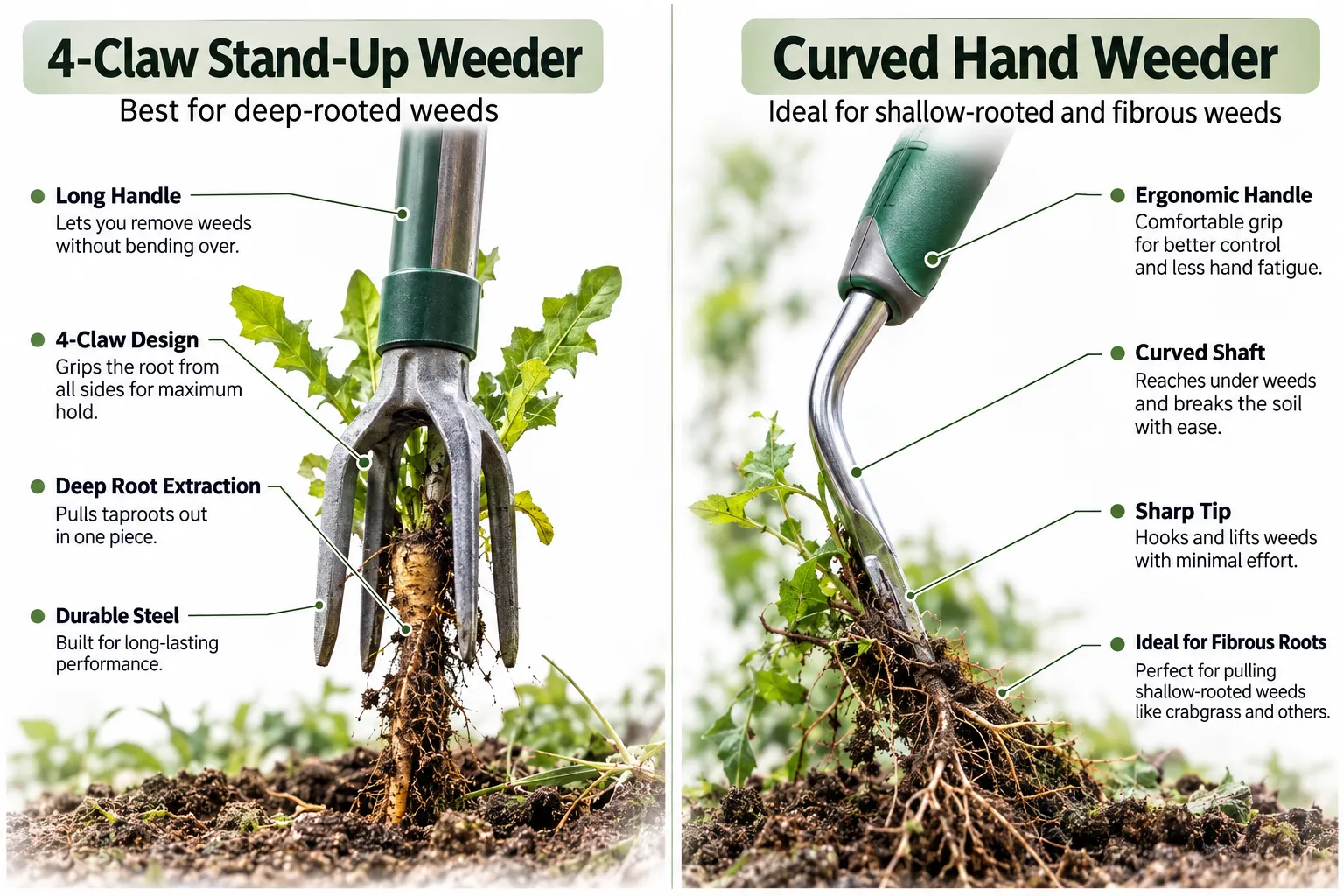
When dealing with deep-rooted invasives, leverage is everything. The Fiskars 4-Claw Stand Up Weeder is a modern staple in this category. It features a 39-inch ergonomic shaft and four serrated stainless-steel claws designed to grab weeds by the root, eliminating the need for kneeling or bending [3]. You center the tool over the weed, step on the reinforced foot platform to drive the claws into the soil, and pull back on the handle. The claws clamp shut around the root, pulling it out cleanly.
For those who prefer traditional, time-tested designs, Grampa’s Weeder offers a mechanical advantage that has been in continuous production since 1913 [1]. This tool utilizes a 45-inch bamboo handle and a cast-iron 4-claw head with a lever design [1]. Instead of a pump-action release, you simply tilt the handle toward the lever pad, which pinches the root and levers it out of the ground. It is exceptionally durable and works beautifully in softer soils, though it may require extra effort in hard, compacted clay.
Choose a stand-up weed puller if: You have a large lawn peppered with dandelions, thistle, or broadleaf plantain, and you want to avoid back pain.
Related Reading: For a deeper dive into long-handled options, read our complete guide on the Best Stand-Up Weed Pullers for Removing Deep-Rooted Weeds.
Best Hand Weeders for Precision Root Extraction
Hand weeders are compact, specialized hand tools engineered to navigate tight spaces between delicate perennials and vegetables, allowing you to extract invasive roots without disturbing the surrounding plants. These tools are essential for raised beds, container gardens, and densely planted borders where a large stand-up tool would cause collateral damage.
The CobraHead Original Hand Weeder is engineered with a forged steel, curved blade that acts as a “steel fingernail” for precision weeding, cultivating, and furrowing in tight soil spaces [4]. The unique curve of the blade provides a natural fulcrum. You plunge the tip into the soil right next to the weed’s crown and pull back; the curved neck rests against the dirt, levering the root out with minimal wrist strain. It is highly effective against grass runners and taproots alike.
Ergonomics also play a massive role in hand weeding fatigue. The Radius Garden 205 PRO Ergonomic Weeder incorporates a patented O-handle design [2]. This circular grip allows you to hold the tool at a natural, neutral wrist angle, maximizing your pushing and pulling power while minimizing the risk of carpal tunnel strain. The blade itself is serrated and notched at the tip, making it perfect for slicing through tough, fibrous root mats.
Choose a hand weeder if: You are working on your knees in raised beds or dense flower borders where precision is more important than clearing large areas quickly.
Related Reading: Explore more ergonomic options in our review of the Best Hand Weeders for Removing Deep-Rooted Garden Weeds.
Multi-Purpose Powerhouses: Hori Hori Knives
A hori hori knife is a traditional Japanese gardening tool featuring a heavy, semi-dished steel blade with one serrated edge and one straight edge, designed for digging, sawing, slicing, and measuring all in one implement. If you only have room for one hand tool in your gardening bucket, this is the one to choose.
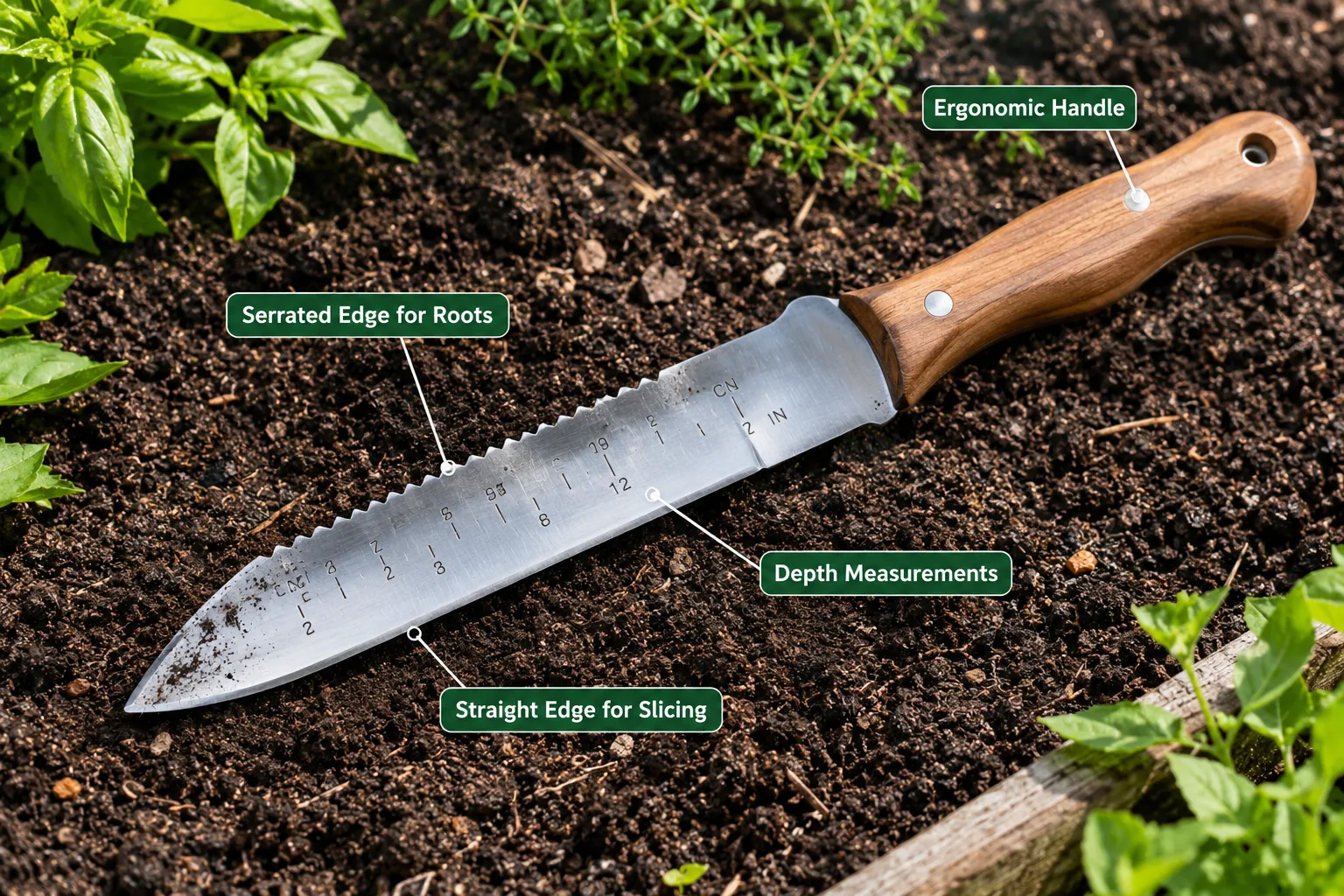
The Nisaku NJP650 Hori-Hori Weeding Knife is highlighted by experts for its 7.25-inch Japanese stainless steel blade, which includes both straight and serrated edges for cutting through tough roots and dividing perennials [5]. The straight edge is razor-sharp for slicing weeds just below the soil surface, while the serrated edge functions as a saw to cut through thick, woody roots that a standard trowel cannot handle.
Because the blade is slightly concave, it acts like a narrow scoop, allowing you to dig out deep taproots with surgical precision. Most hori hori knives also feature inch and millimeter markings stamped directly into the steel, making them incredibly useful for measuring planting depths for bulbs and seeds after you finish weeding.
Choose a hori hori knife if: You want a versatile, heavy-duty tool that can transition instantly from weeding to planting, dividing, and light pruning.
Related Reading: See our top picks for Japanese steel in our guide to the Best Hori Hori Garden Knives for Weeding, Digging, and Planting.
Best Weed Removal Tools for Driveways and Patios
Crack weeders feature an L-shaped or hook-shaped blade designed specifically to slide into the narrow joints between paving stones, concrete slabs, and brick walkways to slice weeds at their base. Attempting to pull weeds from concrete cracks by hand usually results in the stem snapping, leaving the root safely hidden under the pavement to grow back next week.
A good crack weeder has a blade thin enough to fit into a millimeter-wide gap, but strong enough not to bend when dragged against concrete. The sharp inner angle of the tool hooks the weed’s crown and severs it. While this does not always extract the entire root (since the root is trapped under concrete), repeatedly slicing the weed down to the pavement will eventually starve the root system of sunlight, killing the plant.
Choose a crack weeder if: You are battling crabgrass, moss, or dandelions growing in the expansion joints of your driveway, sidewalk, or paver patio.
Related Reading: Keep your hardscaping clean with our guide to the Best Crack Weeders for Driveways, Patios, and Sidewalks.
Heavy-Duty Clearing: Hoes and Sickles
When you need to clear a large, overgrown area of garden bed or prep a new vegetable plot, individual root extraction is too slow; you need long-handled cutting tools like hoes and sickles to rapidly sever weeds just below or immediately above the soil line.
A scuffle hoe (also known as a hula hoe or stirrup hoe) features a heavy-duty steel loop that oscillates back and forth. As you push and pull the tool through the top inch of soil, the sharp edges slice weed stems off at the root crown. This is incredibly fast and leaves the severed weeds on the surface to dry out and die in the sun. For taller, thicker brush and vines, a garden sickle with a curved, serrated blade allows you to grab and slash through overgrown vegetation with a single swing.
Choose a hoe or sickle if: You are clearing large, unplanted garden beds, vegetable rows, or overgrown brush where individual root extraction would take days.
Related Reading:
Top Picks: 10 Best Weed Removal Tools for 2026
Below is our curated list of the top-rated weed removal tools available on Amazon this year, categorized by their specific gardening application.
- [Placeholder for Amazon Affiliate Link 1], Best Overall Stand-Up Weeder
- [Placeholder for Amazon Affiliate Link 2], Best Traditional Claw Weeder
- [Placeholder for Amazon Affiliate Link 3], Best Ergonomic Hand Weeder
- [Placeholder for Amazon Affiliate Link 4], Best Precision Curved Weeder
- [Placeholder for Amazon Affiliate Link 5], Best Hori Hori Garden Knife
- [Placeholder for Amazon Affiliate Link 6], Best Heavy-Duty Hori Hori
- [Placeholder for Amazon Affiliate Link 7], Best L-Shaped Crack Weeder
- [Placeholder for Amazon Affiliate Link 8], Best Stirrup/Scuffle Hoe
- [Placeholder for Amazon Affiliate Link 9], Best Traditional Garden Hoe
- [Placeholder for Amazon Affiliate Link 10], Best Serrated Garden Sickle
- [Placeholder for Amazon Affiliate Link 11], Best Kneeling Pad & Tool Set
(Note: Product availability and pricing are subject to change. Always check current reviews and specifications before purchasing.)
How to Choose the Right Tool for Your Soil
The most common mistake gardeners make is buying a tool without considering their native soil conditions. A tool that glides effortlessly through sandy loam might bend or bounce off dense, dry clay.
| Tool Type | Best For | Ideal Soil Type | Primary Advantage |
|---|---|---|---|
| Stand-Up Claw | Taproots (Dandelions) | Loam, Moist Clay | Zero back strain, deep root extraction. |
| Curved Hand Weeder | Fibrous roots, tight spaces | All soil types | Maximum leverage for stubborn roots. |
| Hori Hori Knife | Deep roots, dividing plants | Hard, compacted clay | Cuts through thick soils and woody roots. |
| Scuffle Hoe | Large, unplanted areas | Loose, sandy, or tilled | Clears massive areas in minutes. |
| Crack Weeder | Hardscaping joints | N/A (Concrete/Brick) | Fits where no other tool can reach. |
Step-by-Step Weeding Checklist
- Wait for the rain: Always weed 12 to 24 hours after a steady rain (or after deep watering). Moist soil is loose and pliable, allowing roots to slide out intact. Dry soil acts like cement.
- Identify the root: Look at the weed. Does it have a central, carrot-like taproot (dandelion), or a shallow, spreading mat of fibrous roots (crabgrass)?
- Select the tool: Use a stand-up claw or hori hori for taproots. Use a hoe or hand cultivator for fibrous mats.
- Target the base: Never pull from the top leaves. Place your tool as close to the soil line as possible to ensure you are engaging the root crown.
- Leverage, don’t yank: Gently rock the tool back and forth to loosen the soil before applying upward pressure. A slow, steady pull is less likely to snap the root than a fast jerk.
Frequently Asked Questions
What is the best tool for removing dandelions? The best tool for dandelions is a stand-up weed puller with deep-reaching claws, such as the Fiskars 4-Claw Weeder. Dandelions have long taproots; if you do not extract the entire root, the plant will regenerate. Stand-up pullers grab the root deep underground and pull it out whole.
Is it better to pull weeds or hoe them? It depends on the weed and the location. Pulling is better for taproot weeds (like thistle and dandelions) because leaving any root behind allows them to regrow. Hoeing is better for clearing large areas of shallow, fibrous-rooted weeds (like chickweed) on a hot, dry day, as the severed tops will quickly die in the sun.
Why do weeds keep coming back after I pull them? Weeds return primarily because the taproot or rhizome was left in the soil. Snapping the stem off at the surface removes the visible plant, but the underground root system stores enough energy to push up new growth. Using a tool that extracts the root entirely is the only permanent solution.
Can I use a hori hori knife for everyday planting? Yes. A hori hori knife is incredibly versatile. Beyond weeding, its sharp edges can open bags of mulch, its concave shape acts as a trowel for digging planting holes, and its built-in ruler helps measure the correct depth for planting bulbs.
Do crack weeders actually work on driveways? Yes, crack weeders are highly effective for hardscaping. While they often slice the weed rather than pulling the full root out from under the concrete, repeatedly slicing the weed down to the pavement deprives the root of the sunlight it needs to survive, eventually killing the plant.
How do you get weeds out of hard clay soil? Do not attempt to weed dry clay. Water the area deeply and wait a few hours, or wait for a rainstorm. Once the clay is moist, use a tool with a forged steel blade, like a hori hori knife or a CobraHead weeder, to carve the soil away from the root rather than trying to pull it straight out.
Conclusion
Equipping yourself with the best weed removal tools transforms a backbreaking weekend chore into a manageable, satisfying task. For expansive lawns plagued by dandelions, a stand-up weed puller is an absolute necessity to protect your lower back. For detailed work in your prized flower beds, investing in a high-quality hori hori knife or an ergonomic hand weeder will give you the precision needed to extract roots without harming your perennials. Evaluate your yard’s specific challenges, choose the tools that match your soil type, and remember that a slow, leveraged pull in damp soil is always more effective than a fast yank in dry dirt.