Last updated: October 17, 2026
Quick Answer: The best stand up weed puller uses a long shaft (typically 39 to 45 inches) and a foot pedal mechanism to drive steel claws deep into the soil. Tools like the Grampa’s Weeder and the Fiskars 4-Claw Weeder grip the taproot at its base, allowing you to extract stubborn weeds like dandelions entirely without bending or kneeling. Choose a heavy-duty cast-iron head for hard clay and a serrated stainless steel model for looser, loamy soils.
Key Takeaways
- Ergonomic relief: Stand-up weeders prevent back and knee strain by utilizing 39- to 45-inch handles, allowing you to work from a completely upright position.
- Root extraction: Four-claw designs provide the most secure grip on deep taproots, ensuring the entire weed is removed so it cannot regrow.
- Leverage is key: Foot pedals increase your downward force, making it significantly easier to penetrate hard, dry, or compacted soil.
- Clean disposal: Integrated ejection mechanisms, such as sliding plungers or spring releases, allow you to drop weeds directly into a yard waste bin without touching them.
- Material matters: Cast-iron heads offer heritage durability but weigh more, while aluminum or carbon steel shafts provide a lightweight, maneuverable alternative.
What Makes the Best Stand Up Weed Puller for Deep Roots?
The most effective upright weeders combine a handle length of at least 39 inches, a step-plate for foot leverage, and serrated steel claws that penetrate deep enough to grab the entire taproot. When evaluating tools for your garden, prioritize the claw mechanism and the handle’s leverage point, as these determine how easily the weed releases from the soil.
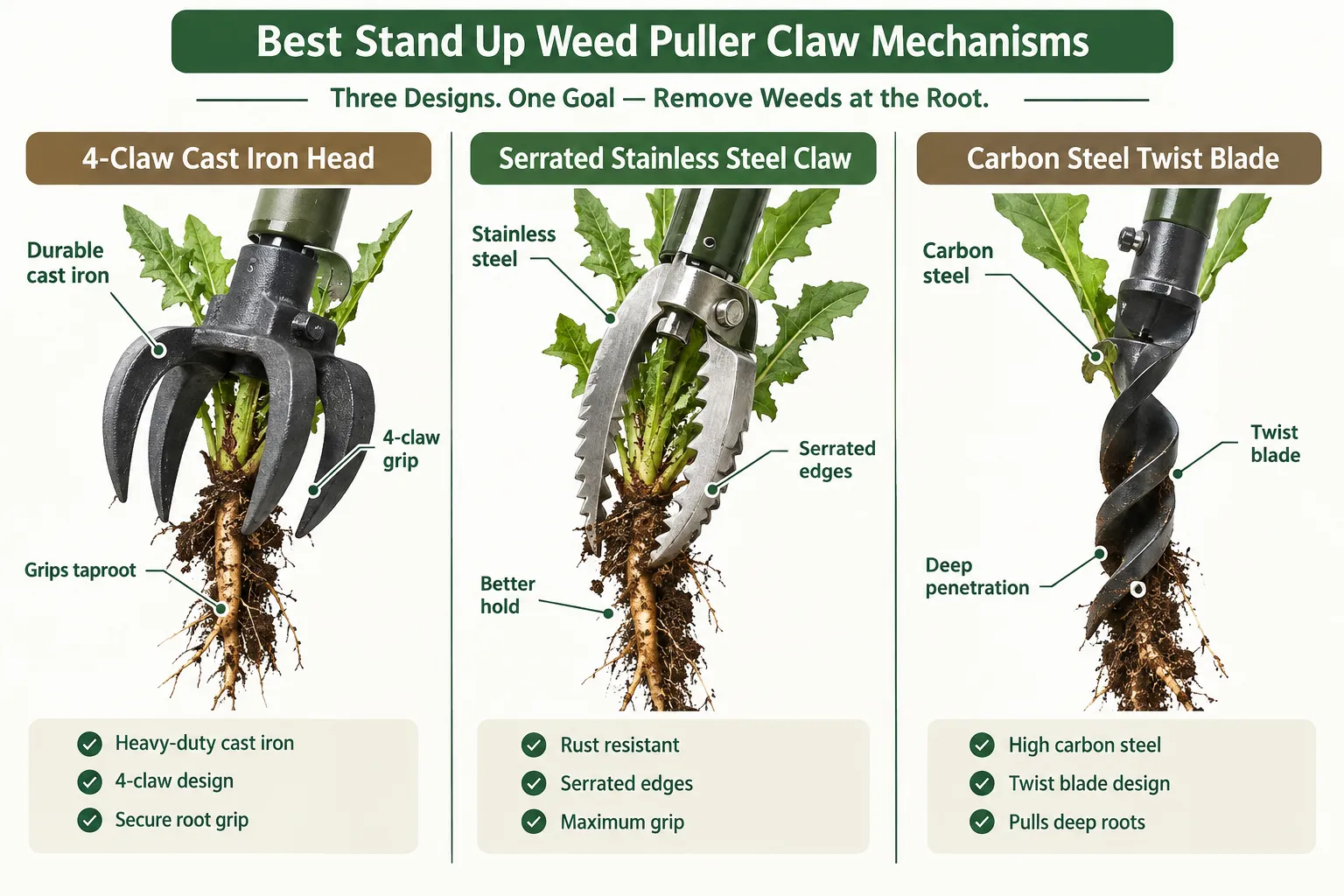
A high-quality weed puller operates on basic physics: it acts as a first-class lever. The foot pad serves as the fulcrum, the long handle is the lever arm, and the claws do the lifting. To find the right tool, you need to look at three primary components:
1. The Claw Design The business end of the tool dictates its success. Most premium models feature three or four claws. Four-claw designs generally offer superior grip on thick taproots because they surround the root from all sides. Serrated edges on these claws help slice through surrounding soil and minor lateral roots, reducing the resistance when you pull back on the handle.
2. Handle Length and Material If you have to stoop to use a stand-up tool, it defeats the purpose. Look for a handle between 39 and 45 inches long. Bamboo and hardwood handles offer traditional aesthetics and excellent shock absorption, while tubular steel or lightweight aluminum provide weather resistance and durability. For a deeper dive into matching handle types to your specific yard chores, check out our guide on the Best Weed Removal Tools for Every Gardening Task.
3. The Ejection Mechanism Pulling the weed is only half the job; getting it off the tool is the other half. Modern weed pullers feature ejection systems to keep your hands clean. These typically come in two styles: a slide-action pump on the handle or a spring-loaded release. While highly convenient, moving parts can jam with wet clay, so simple mechanical levers often outlast complex spring systems in heavy soils.
Top Stand-Up Weed Pullers of 2026 Evaluated
For 2026, the top-performing models include the heritage-designed Grampa’s Weeder for pure leverage, the Fiskars 4-Claw for ergonomic ejection, and the Garden Weasel Step & Twist for core aeration. Each tool excels in different soil conditions and user preferences.
Here is a breakdown of the top tools on the market, based on their mechanisms, materials, and specific use cases:
- Grampa’s Weeder: Originally designed in 1913, the Grampa’s Weeder features a 45-inch long bamboo handle and a cast-iron 4-claw head [1]. It uses a simple foot-lever action to grip and extract deep taproots like dandelions without requiring the user to bend over [1]. Because it lacks complex springs or plastic ejection sliders, it is incredibly durable and rarely jams, making it a favorite for traditionalists.
- Fiskars 4-Claw Stand-up Weeder: The Fiskars model is a 39-inch tool that utilizes four serrated, stainless steel claws to firmly grasp weeds and their roots [6]. It incorporates an integrated spring-operated ejection mechanism on the handle to clear the head without manual removal [6]. This tool is exceptionally lightweight, making it ideal for gardeners who want to move quickly across a large lawn.
- Garden Weasel Weed Popper Step & Twist: Engineered with a carbon steel blade and a foot pedal, this tool requires the user to step down and twist the handle to extract the weed and its root system [2]. It is followed by a push-release mechanism to eject the soil plug [2]. The twisting motion is particularly effective in dense turf where standard prying might tear the surrounding grass.
- Ames Stand-Up Weeder: The Ames Stand-Up Weeder features a 40-inch steel handle with an ergonomic T-grip and a step-plate that drives the serrated steel prongs into the soil [3]. It specifically targets deep-rooted weeds and comes complete with a slide-action ejection plunger [3]. The T-grip provides excellent control for users with weaker grip strength.
- Corona Tools ComfortGEL Weed Puller: Designed with a 39-inch reach, this tool includes a proprietary ComfortGEL grip for ergonomic use [4]. Alongside a quick-release plunger to eject deep-rooted weeds and soil plugs directly into a yard waste bin, it minimizes hand fatigue during extended weeding sessions [4].
- Radius Garden Upright Weeder: Known for their distinct O-handle designs, Radius Garden tools provide a unique ergonomic grip that reduces wrist strain [5]. Their upright weeder uses a stainless steel blade designed to core out the weed, making it highly effective in soft, loamy garden beds [5].
For gardeners specifically battling yellow blooms in their turf, you can compare specialized tools in our roundup of the Best Dandelion Weed Pullers for Getting to the Root.
How to Choose the Right Tool for Your Soil Type
Match your weed puller’s claw design to your yard’s soil density; use heavy-duty cast iron for hard clay and serrated stainless steel for loose, sandy, or loamy soils. The composition of your soil dramatically impacts how a weed puller performs.
If you buy a tool designed for soft garden beds and use it in baked clay, you risk bending the prongs or snapping the handle.
- For Heavy Clay Soil: Clay holds onto roots tightly and turns rock-hard in the summer. You need a tool with thick, unbendable prongs. Cast iron is your best bet here. Choose the Grampa’s Weeder if your soil is dense, heavy, or rocky, as the solid cast-iron head will not warp under heavy foot pressure.
- For Loamy or Sandy Soil: Loose soil makes it easy to insert the tool, but harder to grip the weed, as the soil falls away from the root. You need claws that clamp tightly together. Choose the Fiskars 4-Claw Weeder if you have well-amended garden beds, as the serrated stainless steel claws pinch tightly to grab the root even when the soil is loose.
- For Dense Turf/Lawn: When weeding in the middle of a prized lawn, you want to minimize the size of the hole left behind. Choose the Garden Weasel Step & Twist if you are weeding in thick grass, because the twisting core action removes a neat, small plug rather than tearing up a massive chunk of turf.
If you are unsure about your soil composition and need a versatile option, read more about Which Weed Puller Works Best for Deep-Rooted Weeds?.
Step-by-Step: How to Remove Weeds Without Bending
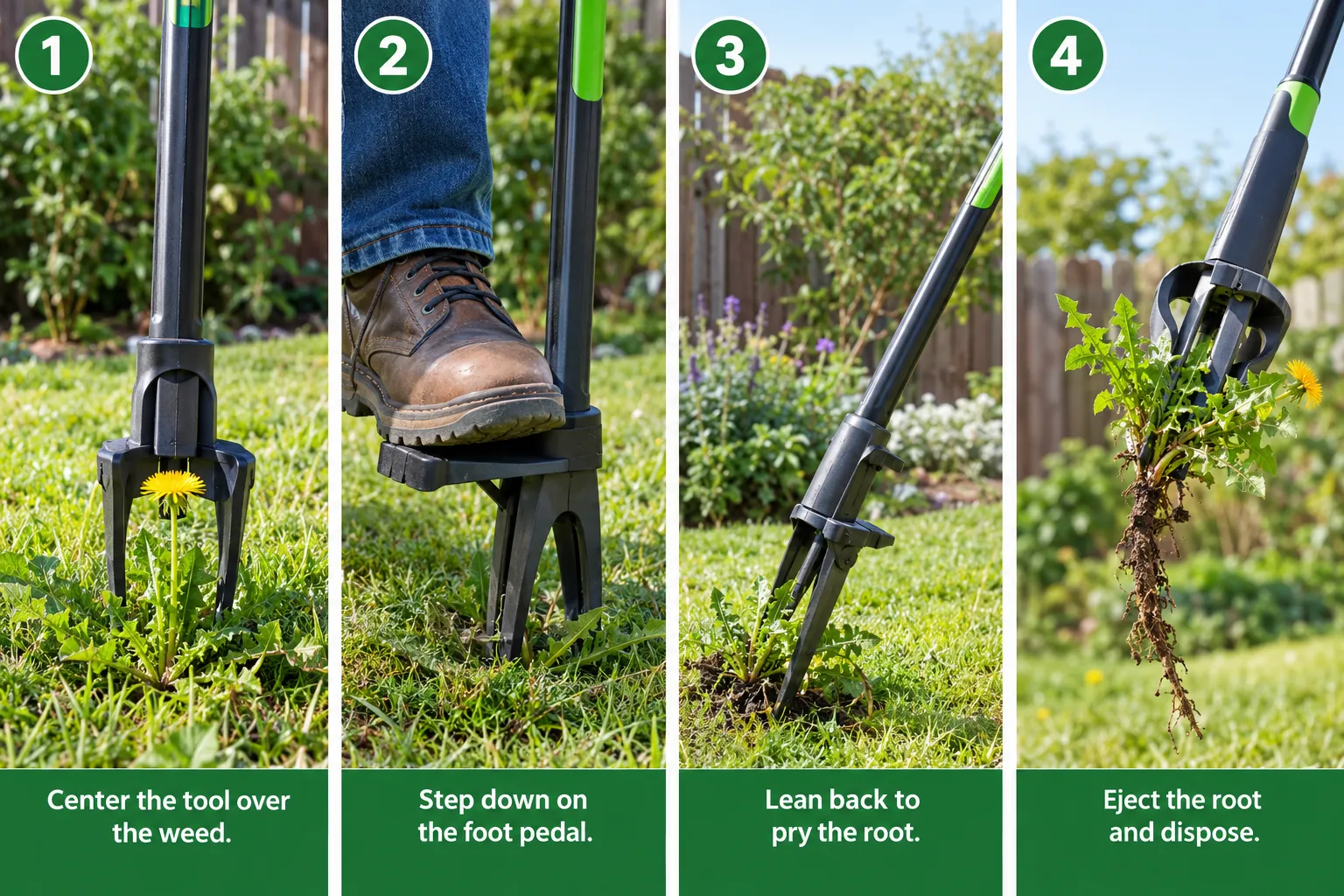
Operating a stand-up weed puller requires centering the tool over the weed, stepping down on the pedal to drive the claws into the soil, and leaning the handle back to pry the root out. Proper technique ensures you get the whole root and prevents damage to the tool.
Using an upright weeder is simple, but rushing the process usually results in snapped roots. Follow these steps for a clean extraction:
- Center the Claws: Position the open claws directly over the center of the weed. For dandelions, aim exactly for the middle of the rosette where all the leaves meet.
- Step Down Firmly: Place your foot on the step-plate or pedal. Push straight down using your body weight. Do not kick or stomp the pedal, as this can bend the prongs if you hit a hidden rock. Drive the tool down until the pedal is flush with the grass.
- Leverage Backward (or Twist): For lever-based tools, pull the handle straight back toward you. The foot pad will act as a fulcrum, and the claws will pinch shut underground, gripping the taproot and lifting it out. For twist-based tools, rotate the handle 180 degrees before pulling up.
- Eject the Weed: Lift the tool over your yard waste bag or compost bin. Engage the slide-plunger, push the release button, or manually open the lever to drop the weed.
For more strategies on preserving your joints in the garden, explore our guide on How to Remove Weeds Without Constant Bending or Kneeling.
Targeting Specific Weeds: Dandelions, Thistles, and Taproots
The best stand up weed puller is specifically engineered to target taproots, making them highly effective against dandelions, thistles, and plantain, but less effective against spreading grass weeds.
Understanding the root structure of your target weed is crucial. Stand-up pullers are precision tools. They excel at extracting weeds that grow a single, thick, carrot-like root straight down into the earth.
Dandelions: The quintessential target for an upright weeder. A dandelion’s taproot can grow up to 10 inches deep. If you leave even an inch of the root in the ground, the weed will regenerate. A four-claw tool driven deeply into the soil is the most reliable way to extract the entire length.
Thistles: Bull thistles and Canadian thistles have deep, aggressive root systems and sharp, spiky leaves. An upright weeder is perfect for thistles because it allows you to remove the plant without ever touching the painful foliage with your hands.
Broadleaf Plantain: These weeds have a dense, fibrous root system that sits closer to the surface but grips the soil tightly. A twisting tool works exceptionally well here, cutting a clean circle around the fibrous mass and lifting it out as a single plug.
What they don’t work on: Creeping weeds like bindweed, creeping Charlie, or crabgrass. These weeds spread via shallow, horizontal runners (rhizomes and stolons). A stand-up taproot puller will only punch a hole in the middle of the weed without addressing the sprawling network of roots. For horizontal spreaders, a traditional hoe or a specialized crack weeder is a better choice.
Common Mistakes When Using Upright Weeders
The most frequent error is pulling the handle straight up instead of leveraging it backward, which snaps the taproot and leaves the base in the ground to regrow. Avoiding a few common pitfalls will extend the life of your tool and keep your lawn weed-free.
Mistake 1: Weeding in Bone-Dry Soil Trying to pull weeds during a drought is an exercise in frustration. Hard, dry soil acts like concrete around a taproot. When you pry back, the root will snap, and you risk bending the steel prongs of your tool. Fix: Always weed the day after a good rain, or water your lawn thoroughly a few hours before you plan to weed. Moisture lubricates the soil, allowing the root to slide out whole.
Mistake 2: Pulling Straight Up Many beginners step on the pedal and then try to deadlift the tool straight vertically. Most upright weeders are designed as levers. Pulling straight up defeats the mechanism, fails to close the gripping claws, and strains your shoulders. Fix: Always tilt the handle backward, using the foot pedal as a pivot point against the ground.
Mistake 3: Aiming Off-Center If you place the tool slightly to the side of the weed’s crown, the claws will slice cleanly through the taproot underground, leaving the bottom half to regrow next week. Fix: Take an extra second to brush the leaves aside and find the exact center of the weed before stepping down.
If you are dealing with weeds growing outside the lawn, such as in pavement joints where a stand-up taproot puller won’t fit, you will need a different approach. See our recommendations for the Best Crack Weeders for Driveways, Patios, and Sidewalks.
Maintenance and Care for Stand-Up Weed Pullers
Rinsing the metal claws after each use and applying a light coat of penetrating oil to moving parts ensures your weed puller won’t rust or jam during the growing season.
Because these tools are constantly plunged into damp soil, they are highly susceptible to corrosion. A rusty tool creates friction, making it harder to push into the ground and causing ejection sliders to stick.
- Clean immediately: Keep a stiff bristle brush near your garden hose. Brush off heavy mud and rinse the claws before putting the tool away.
- Dry thoroughly: Never store a wet tool in a dark shed. Leave it in the sun for twenty minutes to dry completely.
- Lubricate springs: For tools with ejection mechanisms, spray a silicone-based lubricant or WD-40 onto the springs and sliding shafts once a month.
- Care for wooden handles: If your tool has a bamboo or hardwood handle, wipe it down with boiled linseed oil once a year to prevent the wood from drying out and splintering.
Pro Tip:
If your tubular steel handle feels loose where it connects to the claw head, check for a small hex nut or Phillips screw at the joint. Tightening this hardware at the start of every spring will prevent the shaft from wobbling or snapping under pressure.
Frequently Asked Questions (FAQ)
Do stand-up weed pullers actually work on dandelions? Yes. Upright weed pullers are specifically designed for taproots, making them the most effective manual tool for permanently removing dandelions without leaving root fragments behind.
Can I use an upright weeder in rocky soil? You should limit use in heavily rocky soil. Hitting a large, hidden rock with full body weight on the foot pedal can bend or break the steel prongs. If you have rocky soil, proceed slowly and stop pushing if you feel hard resistance.
What is the best handle length for a weed puller? The ideal handle length is between 39 and 45 inches. This accommodates most adults from 5’4″ to 6’2″ without requiring them to stoop or hunch over during use.
Are plastic ejection sliders durable? Plastic components reduce the tool’s weight but are prone to cracking over time, especially if left in freezing temperatures or direct sunlight. Metal ejection mechanisms or simple lever designs tend to last significantly longer.
Does the twist method work better than the pry method? The twist method (used by tools like the Garden Weasel) works best in dense turf because it cuts a clean plug, minimizing damage to surrounding grass. The pry method (used by Grampa’s Weeder) is faster and better for heavy clay.
How heavy are stand-up weed pullers? Weight varies by material. Aluminum and plastic models weigh around 2 to 3 pounds, making them easy to carry. Cast-iron and hardwood models can weigh 4 to 5 pounds, requiring more effort to carry but providing better downward momentum.
Do I need to fill the holes left by the weed puller? In most lawns, the small, 1-inch holes left by a weed puller will naturally fill in with surrounding soil and grass after a few rainstorms. However, if you extract dozens of weeds from a small area, sprinkling a handful of topsoil and grass seed into the holes is recommended.
Conclusion
Investing in the best stand up weed puller transforms a grueling, back-breaking chore into a quick, satisfying task. By leveraging gravity and simple mechanics, these tools allow you to extract deep taproots permanently without ever kneeling in the dirt.
When making your choice for 2026, let your soil type guide you. Opt for the rugged cast-iron simplicity of a lever-style puller if you battle dense clay, or choose a lightweight, spring-ejection model if you have loose soil and a large yard to cover. Keep the soil slightly moist before you weed, aim dead center on the crown, and let the tool do the heavy lifting.
1 thought on “Best Stand-Up Weed Pullers for Removing Deep-Rooted Weeds”
Comments are closed.