Last updated: October 17, 2026
Quick Answer
The best Hori Hori garden knife for most gardeners in 2026 is the Nisaku NJP651, a Japanese stainless steel tool with a traditional wooden handle, premium leather sheath, and a hardness rating around HRC58 that balances sharpness with durability [3]. For heavy-duty soil and dividing tough perennials, the Barebones Hori Hori Ultimate II (released October 2026) offers a full-tang blade built for maximum strength [5]. For budget-conscious gardeners, the Fiskars and Corona CT15409 deliver solid performance without the premium price tag [6][8].
Key Takeaways
- Full-tang construction is the most important durability feature, partial tangs can snap under leverage in tough soil [7]
- Stainless steel (ideally Japanese or 440 grade) resists rust and holds an edge better than generic “stainless” of unspecified grade [2][3]
- A quality Hori Hori knife replaces multiple tools: trowel, weeder, saw, and measuring gauge
- Depth markings on the blade help with consistent planting depth for bulbs and seeds
- Expect to spend $25,$60 for a solid mid-range knife, or $60,$100+ for premium full-tang models
- Sharpen the smooth edge with a flat stone and the serrated edge with a tapered rod or diamond hone
- Beginners find Hori Hori knives intuitive, the shape functions like a trowel but with more precision
- Wood handles offer classic feel; synthetic handles resist weather damage better
- Left-handed gardeners can use most models, though serration placement favors right-handed users
- A well-maintained Hori Hori knife can last 10+ years with proper care
What Is a Hori Hori Knife and What Is It Used For?
A Hori Hori knife is a Japanese gardening tool with a pointed, slightly curved blade that serves as a combination trowel, knife, and saw. The name translates roughly to “dig dig” in Japanese, and that’s exactly what it does, it digs, cuts, weeds, plants, divides, and measures, all with one tool.
I first picked one up about five years ago when my hand trowel snapped mid-transplant. A fellow community gardener handed me her Hori Hori, and within ten minutes I’d transplanted three tomato seedlings, sliced through a stubborn root, and pulled a dandelion that had been mocking me for weeks. I ordered my own that evening.
Typical uses include:
- Weeding: The narrow blade slides under deep-rooted weeds cleanly
- Planting bulbs and seedlings: Depth markings keep planting consistent
- Dividing perennials: The serrated edge cuts through tough root balls
- Cutting twine or ties: The sharp edge handles garden twine and plant ties
- Scrapting soil from pots: The curved blade scoops like a mini trowel
- Foraging: Many outdoor enthusiasts carry one for wild edibles
The versatility is what makes it stand out. Instead of carrying a trowel, a hand fork, a weeding knife, and pruning shears, you carry one tool that handles most of those jobs.
Best Hori Hori Garden Knife Brands and Models for 2026
The best Hori Hori garden knife models in 2026 span from premium Japanese imports to budget-friendly options that still deliver solid performance. Here’s how the top models compare:
Nisaku NJP651 (Best Overall) [3][4]
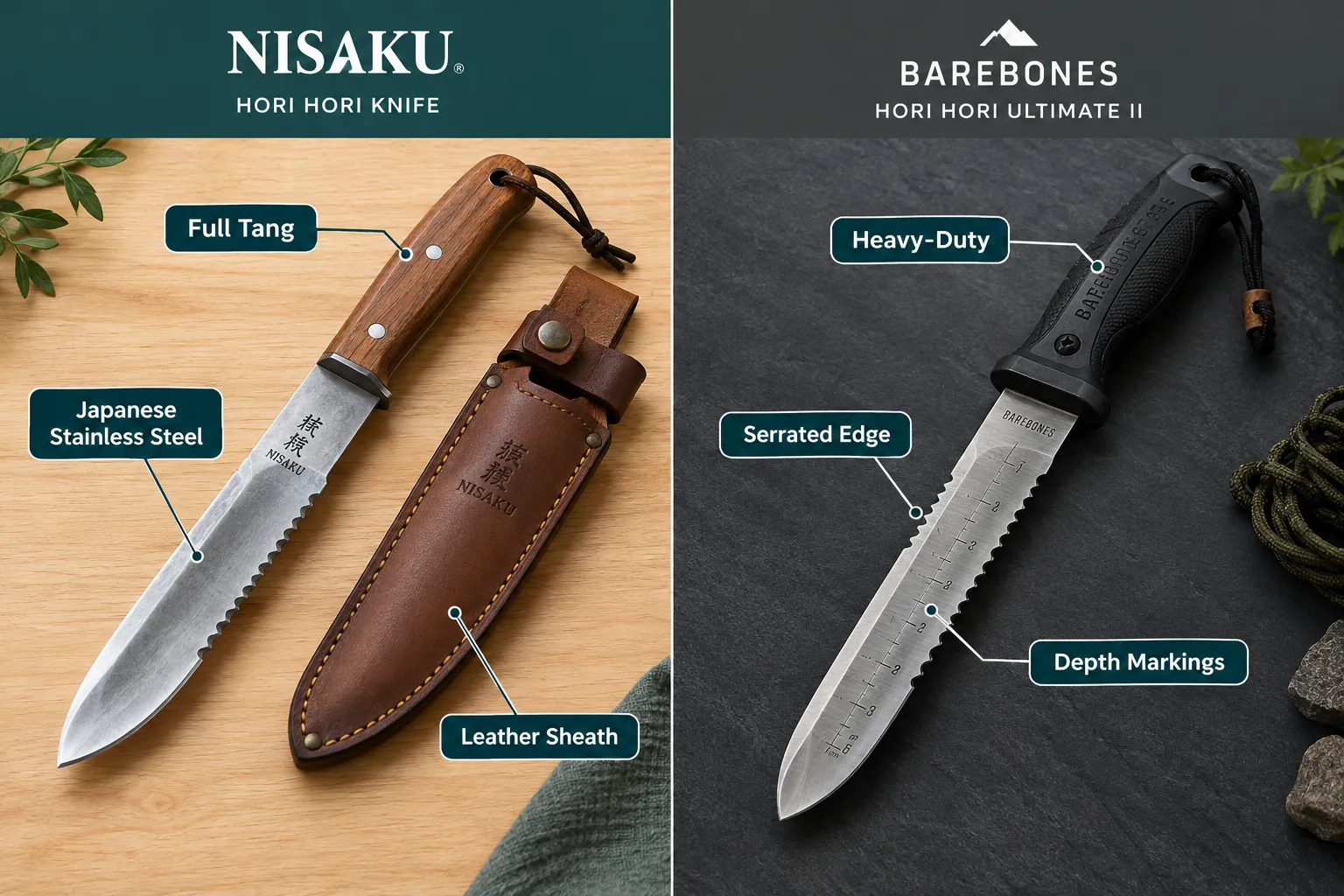
Genuine Japanese stainless steel at approximately HRC58 hardness, traditional wooden handle, and a premium leather sheath. This is the model that consistently tops 2026 roundups from WorthRated, Gardening Products Review, and Wearify. The blade holds an edge well, and the wooden handle provides a comfortable, classic grip. It’s the gold standard for general garden use.
Barebones Hori Hori Ultimate II (Best Heavy-Duty) [5]
Released October 15, 2026, this is Barebones’ upgraded full-tang version of their popular Hori Hori. The full-tang construction means the blade steel extends fully through the handle, eliminating the weak point where partial-tang knives tend to fail. Built for tough soil, gravel, and even camp use.
Truly Garden Hori Hori (Best All-Around Value) [10]
Bob Vila’s testing team selected this as their top pick, praising its full-tang blade, triple-riveted handle, fine serrations, and included sharpening tool. Their tester noted it stood out against other models for balance and comfort. A great middle-ground option.
Corona CT15409 (Best Budget/Compact) [8]
A 6-inch stainless blade with serrated edge. Compact and affordable, ideal for container gardening and precise work in tight spaces. Not a full-tang model, so it’s best for lighter tasks.
Fiskars Hori Hori (Best Budget Comfort) [6]
Fiskars consistently wins “best budget” categories thanks to good ergonomics and a price point that won’t make you wince if you leave it out in the rain (though you shouldn’t).
Decision rule: Choose the Nisaku if you want the traditional experience and general-purpose versatility. Pick the Barebones Ultimate II if your soil is heavy clay or rocky. Go with Corona or Fiskars if you’re on a budget or primarily container gardening.
Hori Hori Knife vs Regular Garden Knife: Which Is Better?
A Hori Hori knife is broader, more versatile, and better for digging than a regular garden knife, which is typically narrower and designed primarily for cutting. A standard garden knife, like a pruning knife or grafting knife, excels at clean cuts on stems and woody material but can’t dig, scoop, or measure depth the way a Hori Hori can.
The Hori Hori’s wider blade (usually 1.5-2 inches) acts as a mini trowel. Its pointed tip pierces soil, and the serrated edge handles roots and small branches. A regular garden knife has a thinner profile, which makes it better for detail cuts but worse for soil work.
Choose a Hori Hori if you do mixed garden work, digging, weeding, planting, and occasional cutting. Choose a regular garden knife if you primarily need precise cutting for grafting, pruning, or harvesting.
For more on how the Hori Hori compares to other common garden tools, check out our guide on Hori Hori Knife vs. Garden Trowel: Which One Do You Need?.
Hori Hori Knife Price: How Much Should You Spend?
A good Hori Hori knife costs between $25 and $100, with most reliable mid-range models landing in the $30,$50 range. Premium full-tang Japanese or specialty models can run $60,$100+.
Here’s the breakdown:
- $15,$25 (Budget): Entry-level models, often partial tang, generic stainless steel. Fine for light weeding and container gardens but won’t hold up in tough soil.
- $25,$50 (Mid-Range): Solid quality from brands like Corona, Fiskars, and Truly Garden. Full-tang options start appearing here. Good balance of durability and value [6][8].
- $50,$100 (Premium): Nisaku NJP651, Barebones Ultimate II, and similar models with premium steel, quality handles, and included sheaths [3][5].
- $100+ (Luxury/Pro): Specialty models with exotic steel or custom features. Overkill for most home gardeners.
Common mistake: Spending $15 on a cheap knife, having it bend or rust within a season, and then buying a $50 model anyway. A mid-range knife from a reputable brand is the sweet spot for most gardeners.
Hori Hori Knife Blade Material: Stainless Steel vs Carbon Steel
Stainless steel is the better choice for most gardeners because it resists rust and requires less maintenance than carbon steel. Carbon steel holds a sharper edge but rusts quickly if not cleaned and oiled after every use.
Most top-rated Hori Hori knives use stainless steel, and 2026 buyer’s guides consistently emphasize this [2][7]. Look for explicit steel grades, Japanese stainless or 440 steel, rather than vague “stainless steel” claims, because the grade is a more reliable indicator of durability than the category alone [2].
| Feature | Stainless Steel | Carbon Steel |
|---|---|---|
| Rust resistance | High | Low |
| Edge retention | Good | Excellent |
| Maintenance | Low | High (oil regularly) |
| Cost | Moderate | Moderate to high |
| Best for | Most gardeners | Experienced users who maintain tools |
The Nisaku NJP651 uses Japanese stainless steel at approximately HRC58 hardness, which means it’s hard enough to hold an edge but not so hard that it chips easily [3]. The Barebones Ultimate II also uses stainless for its full-tang blade [5].
Is a Hori Hori Knife Worth It for Home Gardeners?
Yes, a Hori Hori knife is absolutely worth it for most home gardeners because it replaces multiple tools and handles a wider range of tasks than any single garden hand tool. If you weed, plant, transplant, or divide perennials more than occasionally, it pays for itself in convenience and reduced tool clutter.
I’ve talked to plenty of gardeners who were skeptical at first. “It’s just a fancy trowel,” one neighbor told me. Six months later, she’d given away her old trowel and weeder and used only her Hori Hori for everything.
Who benefits most:
- Vegetable gardeners who transplant seedlings regularly
- Flower gardeners who divide perennials in spring and fall
- Container gardeners who need precision in tight spaces
- Seniors and arthritis sufferers who want fewer tools to manage
- Urban gardeners with limited storage space
Who might not need one: Gardeners who only do light container gardening and already have a comfortable hand trowel they like. For you, a Hori Hori is a nice upgrade but not essential. Check out our guide on best hand weeders for deep-rooted weeds if weeding is your primary concern.
Hori Hori Knife for Beginners: Is It Easy to Use?
Yes, a Hori Hori knife is beginner-friendly because its design is intuitive, you hold it like a trowel and use the pointed end to pierce soil. The learning curve is minimal compared to other specialized garden tools.
Basic technique for first-time users:
- Grip the handle firmly but not tightly
- Push the pointed tip into the soil at the base of the weed or planting spot
- Use a rocking motion to loosen soil around roots
- Pull the weed or place your plant in the opened hole
- Use the flat side to tamp soil back down
Beginner tip: Start with the smooth edge for most tasks. The serrated edge is aggressive and can damage nearby roots if you’re not careful. Use it only for cutting through tough roots or dividing perennials.
For more on planting-specific techniques, see can a Hori Hori knife make planting bulbs easier?.
Hori Hori Knife Sharpening and Maintenance Tips
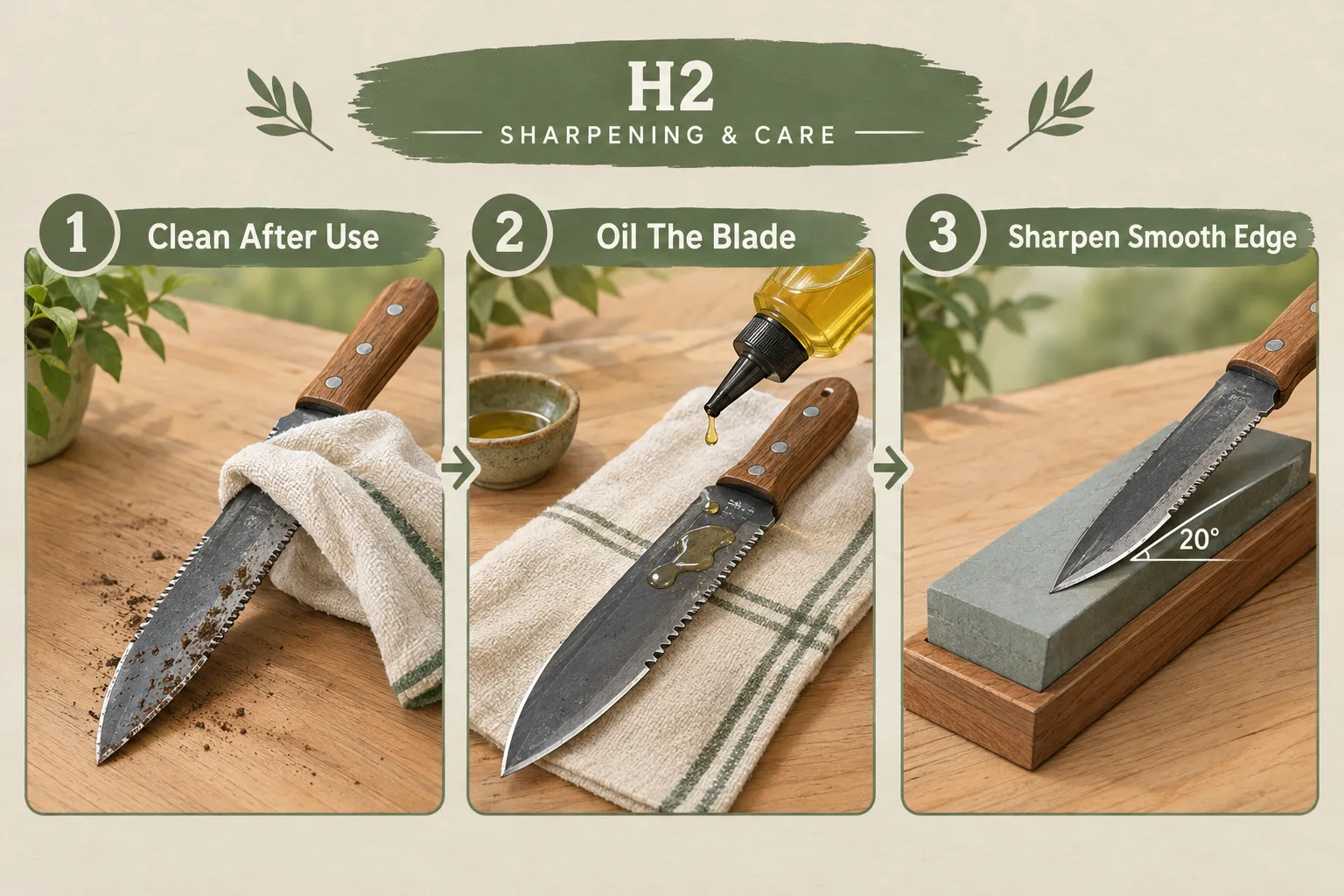
Maintain a Hori Hori knife by cleaning it after each use, drying it thoroughly, oiling the blade occasionally, and sharpening both the smooth and serrated edges separately. Lee Valley’s product guidance recommends using a flat stone for the smooth edge and a tapered rod or diamond hone sized to the serration gullets for the serrated edge.
Maintenance routine:
- After each use: Wipe blade clean with a damp cloth, then dry
- Weekly (during growing season): Lightly oil the blade with mineral oil or camellia oil
- Monthly: Check edge sharpness, if it drags when cutting paper, it’s time to sharpen
- Seasonally: Sharpen the smooth edge with a flat whetstone at about 20 degrees
- As needed: Touch up serrations with a tapered diamond hone
Edge case: If you garden in coastal areas with salt air, oil more frequently and consider storing your knife indoors. Even stainless steel can develop surface rust in high-salt environments.
Common Mistakes When Using a Hori Hori Knife
The most common mistake with a Hori Hori knife is using it as a pry bar, leveraging the blade against rocks or roots at extreme angles can bend or snap even full-tang blades. The second most common error is storing it dirty and wet, which leads to rust and dull edges.
Mistakes to avoid:
- Prying with the tip: The pointed end is for piercing, not levering. If you hit a rock, work around it.
- Storing wet: Always dry before storing, even stainless models
- Ignoring the serrations: Keep them sharp, dull serrations tear roots instead of cutting cleanly
- Using on stones or metal: The blade will chip; Hori Hori knives are soil tools, not masonry tools
- Over-sharpening: Don’t grind the edge down aggressively. Light, regular touch-ups beat heavy regrinding
- Wrong size for your hand: A handle that’s too large or small causes hand fatigue; check grip before buying
Hori Hori Knife Alternatives: What Other Tools Do the Same Job?
A Hori Hori knife is the most versatile single tool, but individual alternatives outperform it for specific tasks. A hand trowel digs deeper holes faster, a stand-up weeder saves your back, and a hori-style weeder with a narrow blade reaches tight spaces better.
When to choose an alternative instead:
- Hand trowel: Better for large transplant holes, but less versatile overall
- Stand-up weed puller: Better for back-saving weeding in lawns
- Cape cod weeder: Better for scraping surface weeds in tight rows
- Digging knife (separate type): Better for heavy prying in rock
For a comprehensive comparison of weeding tools, see our guide on best weed removal tools for every gardening task.
The Hori Hori’s strength is doing 80% of garden tasks well, not being the absolute best at any single one. For most gardeners, that versatility wins.
Where to Buy a Hori Hori Knife Online or In-Store
You can buy a Hori Hori knife online through Amazon, manufacturer websites, and specialty garden retailers, or in-store at well-stocked garden centers and hardware stores. Online offers the widest selection and best pricing; in-store lets you feel the handle and weight before buying.
Online options:
- Amazon: Largest selection, user reviews, fast shipping [9]
- Manufacturer sites: Nisaku, Barebones, Truly Garden all sell direct
- Garden specialty retailers: Often carry curated selections
- HoriHori.com: Dedicated site with their own models [1]
In-store options:
- Local garden centers: Good for hands-on comparison
- Hardware stores: May carry Corona or Fiskars models
- Nursery gift shops: Often stock premium models as gifts
Left-handed options: Most Hori Hori knives work for left-handed gardeners because the blade is symmetrical. The serrated edge is typically on one side, which can affect cutting angle for lefties. Some brands offer left-handed versions, check before purchasing if this matters to you.
Hori Hori Knife Durability: How Long Do They Last?
A quality Hori Hori knife lasts 5-15+ years depending on usage, steel quality, and maintenance. Full-tang models outlast partial-tang ones significantly, and regular cleaning/oiling extends any knife’s life.
Durability factors:
- Tang type: Full tang (blade runs through handle) vs partial tang (blade inserts partway), full tang wins for longevity [7]
- Steel grade: Japanese stainless or 440 steel holds up better than generic stainless [2]
- Handle material: Wood can crack if dried out; synthetic resists weather but may feel less comfortable
- Maintenance: Regular cleaning, drying, and oiling dramatically extend lifespan
- Usage intensity: Light weeding in loamy soil vs heavy prying in clay, the latter wears any tool faster
Weight considerations: 2026 comparisons note that tested Hori Hori knives range from about 9.5 ounces to roughly 1 pound [7]. Lighter knives (9-11 oz) are more comfortable for extended daily use but offer less prying power. Heavier knives (12-16 oz) handle tough soil better but can fatigue your hand faster during long sessions.
Hori Hori Knife With Measurements and Markings on Blade
Depth markings on a Hori Hori blade help you plant bulbs and seeds at consistent depths without a separate measuring tool. Most premium models include inch or centimeter markings etched or stamped along the blade.
Why markings matter:
- Bulbs have specific planting depth requirements (tulips at 6 inches, crocuses at 3 inches)
- Seed packets specify planting depth for optimal germination
- Transplanting seedlings at consistent depth improves establishment
- Markings eliminate guesswork and reduce transplant shock
The best models have markings on both sides of the blade in both inches and centimeters. If your preferred model lacks markings, you can add them yourself with a permanent marker or by lightly scoring the blade, though factory etching lasts longer.
Conclusion
The best Hori Hori garden knife for you depends on your soil type, budget, and how often you garden. For most gardeners in 2026, the Nisaku NJP651 offers the best overall experience with premium Japanese steel and a classic wooden handle [3]. If you work in tough clay or rocky soil, the Barebones Hori Hori Ultimate II’s full-tang construction handles the abuse [5]. Budget-conscious gardeners get excellent value from Corona and Fiskars models [6][8].
Next steps:
- Assess your soil, is it light and loamy or heavy clay? This determines whether you need full-tang construction.
- Set your budget, $25,$50 covers most gardeners’ needs comfortably.
- Check for included extras, sheaths, whetstones, and depth markings add real value.
- Buy from a retailer with a return policy, so you can test the handle fit.
- Start a maintenance routine from day one, clean, dry, and oil after each use.
A Hori Hori knife is the kind of tool that quietly becomes indispensable. Once you’ve used one for a full growing season, you’ll wonder how you managed without it.
FAQ
What is a Hori Hori knife used for?
A Hori Hori knife is used for digging, weeding, planting, dividing perennials, cutting roots, and general garden maintenance. It replaces several individual tools with one versatile blade.
How much does a good Hori Hori knife cost?
A good Hori Hori knife costs $25,$50 for mid-range models and $50,$100 for premium full-tang versions. Budget models under $20 exist but often lack durability for serious garden use.
Is a Hori Hori knife better than a trowel?
A Hori Hori knife is more versatile than a trowel because it also cuts, saws, and measures depth. A trowel digs deeper holes faster but can’t cut roots or divide plants. For most gardeners, the Hori Hori’s versatility wins.
Can left-handed gardeners use a Hori Hori knife?
Yes, most Hori Hori knives work for left-handed gardeners because the blade shape is symmetrical. The serrated edge placement may favor right-handed cutting, but digging and weeding work fine for either hand.
How do you sharpen a Hori Hori knife?
Sharpen the smooth edge with a flat whetstone at about 20 degrees and the serrated edge with a tapered diamond hone or rod sized to the serration gullets. Lee Valley recommends maintaining each edge separately for best results.
Do I need a full-tang Hori Hori knife?
You need a full-tang Hori Hori knife if you garden in heavy clay, rocky soil, or regularly divide tough perennials. Partial-tang knives are fine for light weeding and container gardening but can snap under leverage [7].
How long does a Hori Hori knife last?
A quality Hori Hori knife lasts 5-15+ years with proper maintenance, cleaning, drying, and oiling after each use. Full-tang models with premium steel last longest.
Can I use a Hori Hori knife for foraging?
Yes, many outdoor enthusiasts use Hori Hori knives for foraging because they function as both a knife and a digging tool. The serrated edge handles woody stems, and the pointed blade digs for roots and tubers.
References
[1] horihori – https://horihori.com/
[2] Best Hori Hori Knives – https://topgardeningtools.com/best-hori-hori-knives/
[3] Best Hori Hori Knives – https://www.worthrated.com/guide/best-hori-hori-knives
[4] Article Best Hori Hori Knife – https://gardeningproductsreview.com/article-best-hori-hori-knife/
[5] Hori Hori Ultimate Ii – https://barebonesliving.com/products/hori-hori-ultimate-ii
[6] Best Hori Hori Knives For Digging And Weeding – https://agricarehub.com/best-hori-hori-knives-for-digging-and-weeding/
[7] Best Hori Hori Knives For Garden Work – https://www.mayfairfarms.com/best-hori-hori-knives-for-garden-work/
[8] Hori Hori Garden Knife Corona 6 – https://shop.mahoneysgarden.com/product/hori-hori-garden-knife-corona-6/
[9] Hori Knife – https://www.amazon.com/hori-knife/s?k=hori+hori+knife
[10] Tool Diy Home Gifts Under 50 2025 – https://www.bobvila.com/reviews/tool-diy-home-gifts-under-50-2025/