Last updated: October 17, 2026
Quick Answer
A weed puller without bending is a long-handled stand-up weeding tool that lets you remove weeds by the root while staying upright. Most use a claw or serrated head that you push into the soil with your foot, then lean back on a lever handle to extract the entire weed. The best models from brands like Fiskars, Grampa’s Weeder, and Landzie cost between $25 and $60 and work well for dandelions, thistles, and other taproot weeds in lawns.
Key Takeaways
- A weed puller without bending uses a foot pedal and lever action to extract weeds from a standing position, eliminating strain on knees and lower back.
- Look for 34-48 inch handles, four-claw stainless steel heads, and easy-eject mechanisms as the most important features.
- The Fiskars 34-inch Stand-Up Weed Puller and Grampa’s Weeder remain the most widely recommended models in 2026, backed by thousands of user reviews.
- Stand-up weeders work best on taproot weeds in loamy or sandy soil. They struggle in compacted clay or with shallow, spreading weeds like crabgrass.
- Always water the area or wait until after rain before using a stand-up weeder. Dry, compacted soil makes the claws harder to push in.
- These tools are ideal for seniors, people with arthritis, and anyone with chronic back pain who still wants to maintain their lawn manually.
- Stand-up weeders leave small holes where weeds are pulled. Backfill with compost and reseed to prevent new weeds from filling the gap.
What Is a Weed Puller Without Bending?
A weed puller without bending is a garden tool with a long shaft and a claw-like head designed to grip and pull weeds from the root while you remain standing. Instead of crouching to dig out each weed by hand, you position the claw over the weed, step on a foot pedal to drive the claws into the soil, and lean the handle back to lever the weed out.
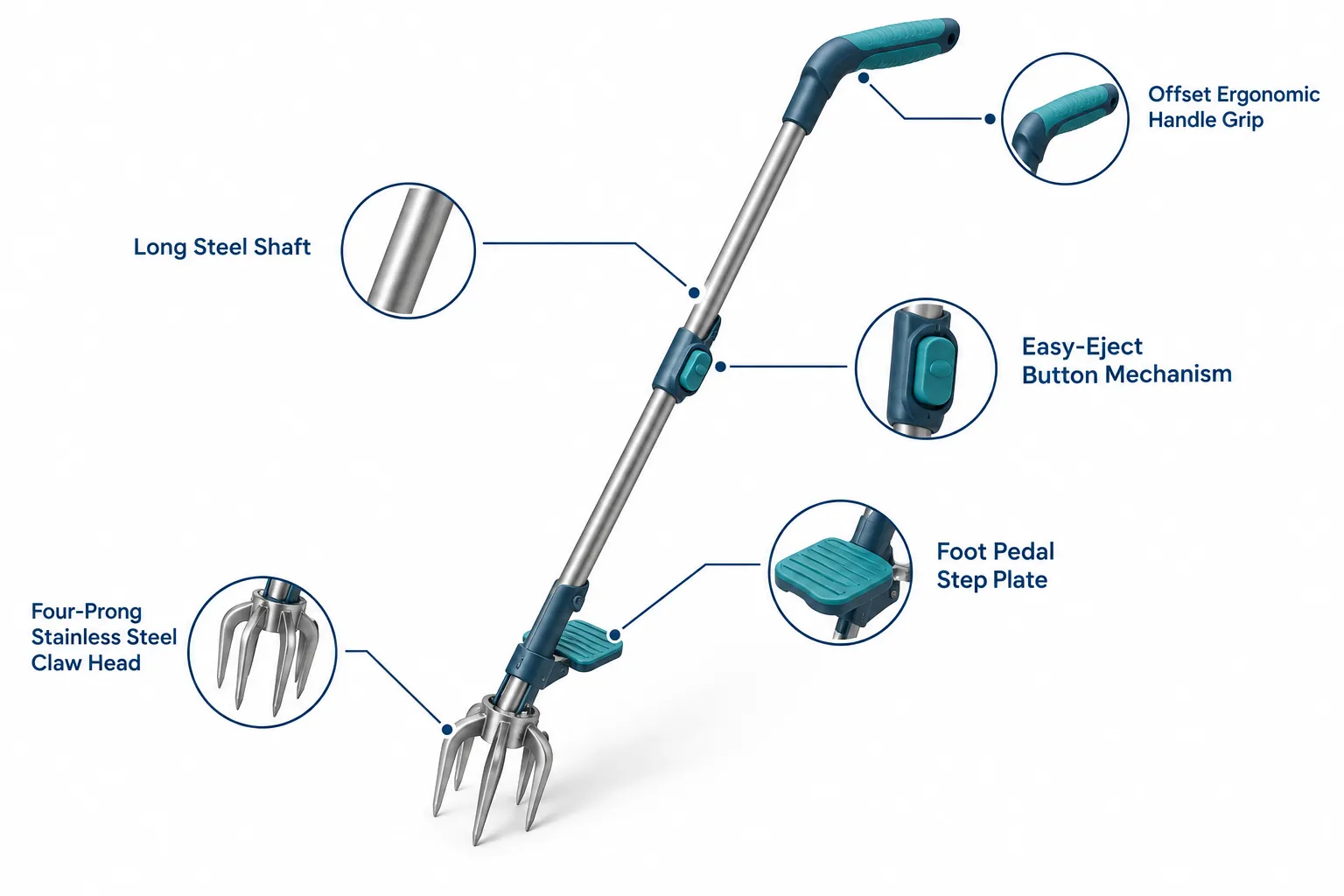
These tools typically have a 34-to-48-inch shaft made of steel or aluminum, a four-prong claw head (sometimes serrated for better grip), and a foot lever that provides the mechanical advantage needed to lift the weed. Some models include an easy-eject button that releases the weed from the claw without reaching down.
The concept has been around for decades. Grampa’s Weeder, one of the most recognizable designs, has been sold since the 1980s and continues to be a top seller in 2026, with over 51,000 ratings on Amazon alone [4][6]. Newer entrants like the Landzie Stand Up Weed Puller, released in October 2026, bring updated materials and marketing emphasis on the same core promise: removing weeds without bending over [1].
Stand-up weeders differ from standard hand weeders in one key way: they trade precision for ergonomics. You can’t easily use one in a tight flower bed or between delicate seedlings, but for lawn weeds with deep taproots, they’re hard to beat.
How Does a Long Handle Weed Puller Work?
A long handle weed puller works on a simple lever principle. You push the claw into the ground over the weed using your foot, then lean back on the handle to lift the entire plant, roots and all, out of the soil. The long handle acts as a lever arm, multiplying the force you apply so that even deep taproots come out intact.
Here’s the step-by-step process most stand-up weeders follow:
- Position the claw over the center of the weed, pressing the tips into the soil.
- Step on the foot pedal to drive the claws down past the root crown. Most designs need a firm push.
- Lean the handle back toward your body. The lever action closes the claws around the root and lifts the weed upward.
- Lift the tool away from the hole once the weed releases.
- Eject the weed using the built-in release button or by tapping the claw against a bucket.
The Fiskars Deluxe Stand-Up Weeder weighs about 2 pounds and uses a 34-inch shaft with an offset ergonomic handle to reduce wrist strain during the lean-back motion [2][9]. Its easy-eject mechanism lets you drop the weed into a bucket without bending down.
The Landzie Stand Up Weed Puller uses four 3-inch serrated steel claws and a foot lever for the same push-step-lean motion [1]. The Target 40-inch model similarly uses a 4-claw stainless-steel design with an offset handle for upright operation [3].
Understanding the mechanics matters because it explains both the strengths and limitations. The lever action excels at lifting deep, single taproots but can struggle with wide-spreading root systems that don’t fit neatly within the claw’s grip.
Do Stand-Up Weed Pullers Actually Work?
Yes, stand-up weed pullers genuinely work for removing weeds with taproots, especially dandelions, thistles, and other rosette-forming broadleaf weeds. Multiple 2026 product tests and editorial reviews confirm that modern stand-up weeders substantially reduce lower-back strain while pulling weeds intact, roots and all [8][10].
The real question isn’t whether they work, but where they work well and where they fall short:
Where they excel:
- Lawns with loose, loamy, or slightly sandy soil
- Weeds with single, thick taproots (dandelions are the classic example)
- Clearing many weeds across a large area
- Gardeners who want to avoid chemical herbicides
Where they struggle:
- Compacted clay soil (the claws can’t penetrate easily)
- Weeds with shallow, spreading root networks
- Tight spaces like between pavers or in densely planted beds
- Very small or grassy weeds that slip through the prongs
A year-long review of the GrootPow Weeder noted that the push-step-lean motion is effective when soil is moist but can leave the tool stuck in dry ground [10]. Bob Vila’s 2026 roundup reached similar conclusions, highlighting that durable steel construction and four-claw heads separate the best tools from cheaper imitators [8].
In my own experience, a stand-up weeder is the first tool I reach for in spring when dandelions erupt across the lawn. It’s not the tool I use for every weed in every bed, but for the right job, it saves time and saves my back.
Best Stand-Up Weed Pullers in 2026
The best stand-up weed pullers in 2026 balance durability, handle length, claw design, and price. Fiskars, Grampa’s Weeder, and Landzie lead the market, with newer options from Target, Woodside, and Garden Gear offering budget-friendly alternatives.
[PRODUCT PLACEHOLDER, 7-9 affiliate products]
Here’s what to look for when comparing models:
| Feature | What It Means | Why It Matters |
|---|---|---|
| Handle length | 34-48 inches | Longer handles keep taller users upright |
| Claw material | Stainless or carbon steel | Stainless resists rust; carbon is tougher |
| Claw count | 3-4 prongs | Four claws grip roots better than three |
| Eject mechanism | Button or lever | Lets you drop weeds without bending |
| Weight | 1.5-3 pounds | Lighter tools reduce fatigue |
| Foot pedal | Flat plate | A wider pedal gives better control |
Top models to consider:
- Fiskars 34-inch Deluxe Stand-Up Weeder: Most widely available. Offset ergonomic handle, easy-eject, about 2 pounds [2][9].
- Grampa’s Weeder (Original): ~45-inch handle, four-claw steel head. Over 51,000 ratings on Amazon [4][6].
- Landzie Stand Up Weed Puller: New for October 2026. Four 3-inch serrated steel claws, foot lever [1].
- Target 40-inch Stand Up Weed Puller: 4-claw stainless-steel head, offset handle, budget-friendly [3].
- Woodside 100cm Long Handle Weed Puller: UK option, stainless steel, launched April 2026 [7].
- Garden Gear Long Handle Weed Puller: UK budget option, about 1 kg, 100cm shaft [5].
Choose Fiskars for a proven, lightweight design. Choose Grampa’s Weeder if you’re tall or want the longest handle. Choose an adjustable model if multiple people of different heights will use it.
For more detail, check out our guide to the best stand-up weed pullers for removing deep-rooted weeds.
Weed Puller Without Bending vs Regular Weeder: Which Is Better?
Neither tool is universally better. A weed puller without bending wins for lawn weeds with taproots when you value back comfort, while a regular hand weeder wins for precision work in flower beds, vegetable gardens, and tight spaces. Most serious gardeners eventually own both.
Stand-up weed puller advantages:
- No bending, kneeling, or crouching
- Faster for clearing many weeds across a lawn
- Pulls deep taproots intact, reducing regrowth
- Works well for seniors and people with mobility issues
Stand-up weed puller disadvantages:
- Less precise than a hand tool
- Can leave sizable holes in the lawn
- Doesn’t work well in compacted or rocky soil
- Limited to weeds that fit within the claw’s grip
Regular hand weeder advantages:
- Precise removal in tight spaces
- Works between plants, in containers, and in raised beds
- Better for shallow-rooted weeds and grasses
- Cheaper and simpler
The right choice depends on your garden. If you’re maintaining a lawn with dandelions and thistles, a stand-up weeder saves your back. If you’re weeding a vegetable bed where precision matters more than speed, a hand weeder is the better tool.
See our guide to the best hand weeders for vegetable gardens and flower beds for precision-weeding recommendations.
Weed Puller Without Bending for Bad Back or Arthritis
A weed puller without bending is one of the best tools for gardeners with back pain, arthritis, or limited mobility. It eliminates the two motions that aggravate lower back and knee problems: repeated bending and kneeling. The lever action does the heavy work, so you apply force with your body weight and arm, not by straining your spine.
Real Simple’s August 2026 feature on Grampa’s Weeder specifically notes that the 45-inch handle makes it easy enough for seniors to use without crouching [4]. Fiskars designed its Deluxe Stand-Up Weeder with an offset ergonomic handle to reduce wrist strain [2][9]. The Garden Gear long-handle puller was reviewed as “reasonably strongly constructed” and praised for eliminating the need to touch problematic weeds like ragwort [5].
If you have arthritis or back issues, prioritize:
- Handle length: 45 inches or longer so you don’t hunch forward
- Weight: Under 3 pounds to reduce arm fatigue
- Eject mechanism: Essential if reaching down is painful
- Grip comfort: Look for padded or contoured handles if grip strength is limited
- Adjustable shaft: Lets each user set their ideal length
One caveat: if your back pain is severe enough that any twisting motion causes discomfort, talk to your doctor before using a lever-action tool. The lean-back motion does engage your core and back, even though it’s gentler than bending.
Can You Use a Stand-Up Weed Puller on Dandelions and Crabgrass?
You can use a stand-up weed puller effectively on dandelions, but it’s less reliable on crabgrass. Dandelions have a single thick taproot that fits perfectly within the claw grip. Crabgrass has a fibrous, spreading root system that doesn’t sit neatly inside four claws.
Dandelions: Ideal target. The taproot is thick enough for the claws to grip firmly, and if you get the claws deep enough, the entire root comes out. The Target 40-inch model specifically calls out dandelions and thistles as weeds its 4-claw design handles well [3].
Crabgrass: Difficult but not impossible. The roots are shallow but spread sideways. The claws may pull the top growth but leave root fragments behind, leading to regrowth.
Other weeds that work well:
- Thistles (especially rosette-stage)
- Plantain (broadleaf)
- Wild carrot
- Any weed with a defined central taproot
Weeds that don’t work well:
- Crabgrass and other spreading grasses
- Clover (shallow, spreading roots)
- Creeping Charlie (root fragments left behind)
- Moss (no root to grip)
For deep-rooted weeds, our guide to the best dandelion weed pullers for getting to the root covers dedicated dandelion tools in more detail.
Weed Puller Without Bending for Clay Soil vs Sandy Soil
Soil type significantly affects how well a weed puller without bending performs. Sandy and loamy soils are ideal because the claws slide in easily. Clay soil is the hardest because it’s dense, sticky when wet, and hard when dry.
Sandy soil: The claws push in with minimal effort. Weeds come out easily because the loose soil releases the root. The trade-off is that sandy soil doesn’t hold roots as tightly, so thin or brittle roots may snap.
Loamy soil: The sweet spot. Enough structure to hold roots firm, but loose enough for claws to penetrate. Most lawns with decent soil fall here, and stand-up weeders perform well.
Clay soil: The biggest challenge. When dry, clay resists claw penetration. When wet, it’s sticky and can clog the mechanism. The lever action requires more force, and the tool can get stuck.
Tips for clay soil:
- Water the area thoroughly the day before weeding
- Wait 24-48 hours so soil is damp but not saturated
- Use a model with wider claws and a longer handle for more leverage
- Avoid weeding in dry summer conditions
- Consider aerating compacted clay lawns long-term
A common mistake is forcing the claws into dry, compacted clay. This bends the prongs, damages the tool, and leaves the weed behind. Soaking the area first is the single most effective fix.
Common Mistakes With Long Handle Weed Pullers & Troubleshooting
The most common mistakes with long-handle weed pullers are using them in dry, compacted soil, not positioning the claw directly over the weed’s center, and failing to clean the claw between uses. These issues cause the tool to get stuck, break, or leave root fragments behind.
Problem: The tool gets stuck in the ground.
This usually happens in clay or compacted soil when the claws go in but can’t come back up. Rock the handle gently side to side while pulling up. Don’t twist forcefully, that bends the shaft. If it’s truly stuck, step on the surrounding soil to loosen it, or pour a small amount of water around the claw and wait a few minutes.
Problem: The weed snaps at the root.
The claws didn’t go deep enough, or the soil was too dry. Push the claw deeper before leaning back, or water the area first. With dandelions, aim for the center of the rosette and push down at least 2-3 inches.
Problem: The claw releases the weed before it’s fully out.
The eject mechanism may be too sensitive, or the weed is too small for the claw to grip. For small weeds, a hand weeder is the better tool.
Problem: The tool leaves large holes in the lawn.
This is inherent to how stand-up weeders work. Every extracted weed leaves a hole roughly the diameter of the root system. Backfill each hole with compost and reseed to prevent new weeds from colonizing the bare soil. One reviewer noted the Garden Gear puller left holes that made their lawn look like a “mini golf course” until they backfilled and reseeded [5].
Problem: The handle feels too short or too long.
If you’re over 5’10”, look for 45-inch or adjustable models. If you’re under 5’4″, a 34-inch model may work better than a 48-inch one, which could force you to reach up uncomfortably.
Who Should Use a Stand-Up Weed Puller?
Stand-up weed pullers are ideal for seniors, people with arthritis or chronic back pain, homeowners maintaining medium-to-large lawns, and anyone who wants to avoid chemical herbicides. They’re less suited for gardeners working primarily in raised beds, containers, or densely planted vegetable gardens.
Best candidates:
- Seniors who want to keep gardening without aggravating joint pain
- People with back pain or arthritis who can’t kneel or bend repeatedly
- Lawn-focused homeowners dealing with dandelions and thistles
- Chemical-free gardeners who prefer mechanical removal
- Landscape maintenance businesses that want to reduce worker fatigue
Less suited for:
- Vegetable gardeners weeding between delicate seedlings
- Container gardeners (no lawn to stand on)
- Gardeners dealing exclusively with spreading weeds like crabgrass
- People with very small urban gardens where a hand weeder covers everything
Even if you fall in the “less suited” category, a stand-up puller can be a useful backup for the occasional dandelion that appears in your lawn path or borders.
Alternatives to Weed Pullers for People Who Can’t Bend
If a stand-up weed puller doesn’t suit your needs, several alternatives allow weed control without bending. Each has trade-offs in cost, effort, and environmental impact. The cheapest options cost under $30, while others require more upfront investment but reduce long-term weeding effort.
- Long-handled hoe or cultivator. A scuffle hoe or stirrup hoe with a long handle slices weeds off at the soil line while standing. Doesn’t pull roots but works well for shallow weeds. Budget-friendly at $20-40.
- Flame weeder. A propane-powered weed torch kills weeds with heat. No bending, but doesn’t remove roots and requires caution near flammable materials. Cost: $40-80.
- Boiling water or vinegar spray. Pouring boiling water on weeds or spraying horticultural vinegar kills top growth without bending. Inexpensive but non-selective and may need multiple applications.
- Landscape fabric and mulch. Preventing weeds is easier than removing them. A layer of cardboard or fabric under mulch suppresses most weeds in beds. Upfront effort but minimal ongoing maintenance.
- Pre-emergent herbicide. Applying corn gluten meal or a chemical pre-emergent in early spring stops weed seeds from germinating. No bending, but timing is critical and it won’t affect existing weeds.
- Hiring help. For gardeners with severe mobility limitations, hiring a local garden maintenance service for periodic weeding may be the most practical option.
Each alternative works best in specific contexts. For lawns with dandelions, a stand-up weed puller remains the most efficient manual method. For vegetable beds, a long-handled hoe may be more practical. For prevention, mulch and fabric reduce the need for any weeding tool at all.
FAQ
Q: How deep do stand-up weed puller claws go?
Most stand-up weeder claws penetrate 2-4 inches. That’s enough for dandelion taproots in loose soil but may not reach the full root in compacted ground.
Q: Can a weed puller without bending remove every weed in my lawn?
No. These tools work best on taproot weeds like dandelions and thistles. They struggle with spreading weeds like crabgrass, clover, and creeping Charlie.
Q: Do I need to water before using a stand-up weeder?
In dry or clay soil, yes. Watering the day before softens the ground and makes claws easier to push in. In loose, loamy soil after rain, you can skip it.
Q: How much do stand-up weed pullers cost?
Most models range from $25 to $60. Budget options like the Target 40-inch and Garden Gear sit at the lower end; premium options like Grampa’s
References
- Landzies Stand Up Weed Puller Tool
- homedepot
- A 1011199362
- Grampas Weeder The Original Stand Up Weed Puller Tool Amazon August 2026 12032634
- 5057898150367 Bq
- B009vhziak
- 5056574905215 Bq
- Best Stand Up Weeders
- Fiskars Stand Up Weed Puller Review
- Grootpow Weeder Review
- B0d2mxlrg8
- Fiskars Stand Up Weeder Amazon June 2026 12007615
- B001d1ffza
- Best Weeding Tools 6753578
- Grampas Weeder The Original Stand Up Weed Puller Tool Amazon Deal July 2026 12020484